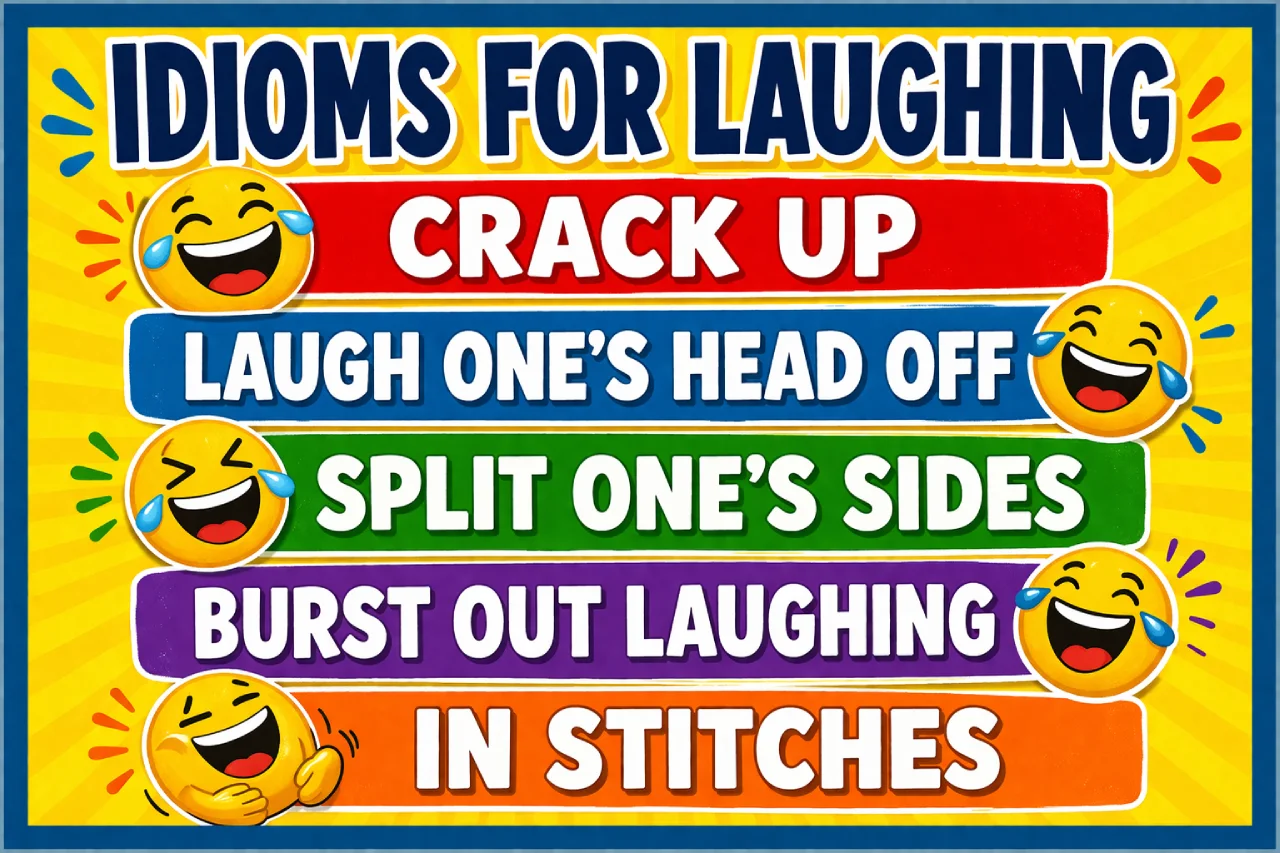
Laughter is one of the most universal human reactions. Whether it’s a quiet chuckle or uncontrollable giggles, laughing connects people and lightens the mood. In English, there are many colorful expressions that describe different ways of laughing—and many of them appear as idioms.
An idiom for laughing is a phrase whose meaning goes beyond the literal words. Instead of simply saying “I laughed,” English speakers often say things like “I cracked up” or “I laughed my head off.” These idioms make language more vivid and expressive.
Language becomes more fun when you use expressive idioms. In this guide featuring 30 idioms for laughing, you’ll learn popular phrases that describe different styles of laughter, each explained with clear meanings and practical examples.
1. Crack Up

Meaning: To laugh suddenly and uncontrollably.
In a Sentence: When he slipped on the banana peel, the entire audience cracked up.
Other Ways to Say: Burst out laughing, lose control laughing, break into laughter
Why It Works: The phrase suggests laughter breaking out like something cracking open.
Best Used For: Informal conversations or describing funny moments.
2. Laugh One’s Head Off
Meaning: To laugh extremely hard.
In a Sentence: We laughed our heads off watching that comedy show.
Other Ways to Say: Laugh uncontrollably, roar with laughter, laugh hysterically
Why It Works: The exaggeration emphasizes how intense the laughter is.
Best Used For: Casual storytelling and describing hilarious situations.
3. Split One’s Sides
Meaning: To laugh so hard it feels painful.
In a Sentence: I nearly split my sides listening to his jokes.
Other Ways to Say: Laugh hysterically, double over laughing
Why It Works: The phrase humorously exaggerates how strong laughter feels.
Best Used For: Funny stories and exaggerated humor.
4. Burst Out Laughing
Meaning: To suddenly begin laughing.
In a Sentence: She burst out laughing when she saw the surprise costume.
Other Ways to Say: Suddenly laugh, erupt in laughter
Why It Works: It captures how laughter can appear unexpectedly.
Best Used For: Narratives and casual conversation.
5. In Stitches

Meaning: Laughing extremely hard.
In a Sentence: The comedian had the audience in stitches the entire night.
Other Ways to Say: Rolling with laughter, laughing uncontrollably
Why It Works: The phrase suggests laughter so intense it might require stitches.
Best Used For: Comedy reviews and humorous stories.
6. Roll on the Floor Laughing
Meaning: Laughing so hard you can’t stay still.
In a Sentence: The prank video had everyone rolling on the floor laughing.
Other Ways to Say: Laugh uncontrollably, laugh hysterically
Why It Works: The image exaggerates the physical reaction to humor.
Best Used For: Internet slang, informal writing, and storytelling.
7. Giggle Like a Schoolkid
Meaning: Laugh in a light, playful way.
In a Sentence: They giggled like schoolkids when the joke finally landed.
Other Ways to Say: Chuckle softly, laugh shyly
Why It Works: Children’s laughter is associated with innocence and joy.
Best Used For: Describing playful or innocent laughter.
8. Laugh All the Way to the Bank
Meaning: To laugh because you made money or succeeded.
In a Sentence: After the movie became a hit, the producer laughed all the way to the bank.
Other Ways to Say: Profit happily, celebrate financial success
Why It Works: The humor comes from laughing about financial success.
Best Used For: Business or success stories.
9. Roar with Laughter
Meaning: Laugh loudly and powerfully.
In a Sentence: The entire theater roared with laughter at the punchline.
Other Ways to Say: Laugh loudly, howl with laughter
Why It Works: The word “roar” suggests powerful sound like a lion.
Best Used For: Describing large audiences or big reactions.
10. Howl with Laughter
Meaning: Laugh loudly and uncontrollably.
In a Sentence: The kids howled with laughter during the silly game.
Other Ways to Say: Roar laughing, laugh wildly
Why It Works: “Howl” evokes loud and joyful sounds.
Best Used For: Playful or lively situations.
11. Laugh Up One’s Sleeve
Meaning: To secretly laugh at someone.
In a Sentence: He laughed up his sleeve after the prank worked perfectly.
Other Ways to Say: Laugh quietly, mock silently
Why It Works: It suggests hidden amusement.
Best Used For: Subtle humor or mischievous moments.
12. Have a Good Laugh
Meaning: To enjoy laughing for a while.
In a Sentence: We had a good laugh remembering our school days.
Other Ways to Say: Share laughter, enjoy a joke
Why It Works: It captures the social side of laughter.
Best Used For: Friendly conversations.
13. Chuckle to Oneself
Meaning: To laugh quietly.
In a Sentence: She chuckled to herself while reading the funny text.
Other Ways to Say: Giggle quietly, laugh softly
Why It Works: It reflects private amusement.
Best Used For: Gentle humor.
14. Snicker Under One’s Breath
Meaning: To laugh quietly in a slightly mocking way.
In a Sentence: The students snickered under their breath when the teacher slipped.
Other Ways to Say: Suppress laughter, laugh quietly
Why It Works: It conveys subtle humor.
Best Used For: Mischievous situations.
15. Die Laughing
Meaning: To laugh extremely hard.
In a Sentence: I nearly died laughing at that joke.
Other Ways to Say: Laugh uncontrollably, laugh hysterically
Why It Works: The exaggeration highlights intense laughter.
Best Used For: Informal conversation.
16. Be Tickled Pink
Meaning: To feel amused and delighted.
In a Sentence: She was tickled pink by the clever joke.
Other Ways to Say: Delighted, amused
Why It Works: The phrase connects laughter with joy.
Best Used For: Lighthearted contexts.
17. Laugh Like a Hyena
Meaning: To laugh loudly and wildly.
In a Sentence: He laughed like a hyena at the ridiculous scene.
Other Ways to Say: Laugh loudly, howl laughing
Why It Works: Hyenas are known for loud, unusual laughter sounds.
Best Used For: Dramatic or exaggerated humor.
18. Laugh Until One Cries
Meaning: Laugh so much that tears appear.
In a Sentence: We laughed until we cried watching the comedy show.
Other Ways to Say: Cry with laughter
Why It Works: Laughter can literally produce tears.
Best Used For: Describing extremely funny moments.
19. Laugh Your Socks Off
Meaning: Laugh very hard.
In a Sentence: That movie will make you laugh your socks off.
Other Ways to Say: Laugh a lot, laugh hysterically
Why It Works: The exaggeration makes the phrase playful.
Best Used For: Casual speech.
20. Be in Fits of Laughter
Meaning: Laugh repeatedly and uncontrollably.
In a Sentence: The prank left everyone in fits of laughter.
Other Ways to Say: Laugh uncontrollably, crack up repeatedly
Why It Works: The phrase suggests waves of laughter.
Best Used For: Group reactions.
21. Laugh Like Crazy
Meaning: Laugh uncontrollably.
In a Sentence: They laughed like crazy at the surprise ending.
Other Ways to Say: Laugh wildly, laugh hysterically
Why It Works: The phrase exaggerates emotional reaction.
Best Used For: Informal conversations.
22. Double Over with Laughter
Meaning: Laugh so hard you bend forward.
In a Sentence: The joke made him double over with laughter.
Other Ways to Say: Bend laughing, collapse laughing
Why It Works: It describes a real physical reaction to humor.
Best Used For: Describing intense laughter.
23. Laugh Out Loud
Meaning: Laugh audibly.
In a Sentence: I actually laughed out loud reading that message.
Other Ways to Say: LOL, laugh openly
Why It Works: It emphasizes genuine amusement.
Best Used For: Casual conversation and online communication.
24. Be in Hysterics
Meaning: Laugh uncontrollably for a long time.
In a Sentence: The audience was in hysterics during the performance.
Other Ways to Say: Laugh wildly, roar laughing
Why It Works: It conveys extreme laughter.
Best Used For: Comedy descriptions.
25. Laugh Like There’s No Tomorrow
Meaning: Laugh freely without restraint.
In a Sentence: They laughed like there was no tomorrow at the reunion.
Other Ways to Say: Laugh wholeheartedly, laugh freely
Why It Works: It emphasizes uninhibited joy.
Best Used For: Celebratory moments.
26. Laugh to Beat the Band
Meaning: Laugh very loudly and intensely.
In a Sentence: The crowd laughed to beat the band at the comedian’s punchline.
Other Ways to Say: Laugh loudly, roar laughing
Why It Works: The phrase exaggerates volume and enthusiasm.
Best Used For: Describing energetic audiences.
27. Laugh Like a Drain
Meaning: Laugh loudly and without restraint.
In a Sentence: He laughed like a drain when he heard the absurd story.
Other Ways to Say: Laugh loudly, howl laughing
Why It Works: The phrase emphasizes loudness.
Best Used For: British-style humor descriptions.
28. Laugh Until Your Belly Hurts
Meaning: Laugh intensely for a long time.
In a Sentence: The stand-up show made us laugh until our bellies hurt.
Other Ways to Say: Laugh uncontrollably, split your sides
Why It Works: Laughter can physically strain muscles.
Best Used For: Casual storytelling.
29. Laugh Away
Meaning: To keep laughing continuously.
In a Sentence: They laughed away the entire evening telling jokes.
Other Ways to Say: Laugh continuously, keep laughing
Why It Works: It highlights ongoing amusement.
Best Used For: Describing relaxed social gatherings.
30. Laugh in Someone’s Face
Meaning: To openly mock someone.
In a Sentence: The villain laughed in the hero’s face.
Other Ways to Say: Mock openly, laugh mockingly
Why It Works: The phrase emphasizes disrespectful laughter.
Best Used For: Dramatic storytelling.
How to Use Idioms for Laughing Naturally
Idioms are powerful because they add personality and emotion to language. Instead of saying “everyone laughed,” phrases like “the audience roared with laughter” or “we cracked up” paint a clearer picture.
These idioms are commonly used in:
- Casual conversation
- Comedy reviews
- Storytelling
- Social media posts
- Creative writing
Choosing the right idiom depends on how intense the laughter is and the tone of the situation.
Final Thoughts
Laughter is universal, but the ways we describe it can be wonderfully creative. The 30 idioms for laughing in this guide show how English speakers capture humor, joy, and amusement through colorful expressions.
Now here’s a simple question for you: Which of these idioms best describes your sense of humor—cracking up, roaring with laughter, or laughing your head off?