Mountains have always fascinated humans. They dominate landscapes, challenge climbers, and symbolize strength, endurance, and ambition. Because of their size and presence, mountains are often used as powerful images in language and storytelling.
A mountain metaphor compares something—such as a challenge, achievement, or person—to a mountain in order to highlight qualities like greatness, difficulty, stability, or perseverance. When someone says they are “facing a mountain of work,” for example, they mean the task is enormous and demanding.
Language becomes more vivid when metaphors bring ideas to life. In this guide featuring 33 metaphors for mountains, you’ll learn expressive comparisons that writers use to describe challenges, power, and natural beauty, along with clear meanings and easy examples.
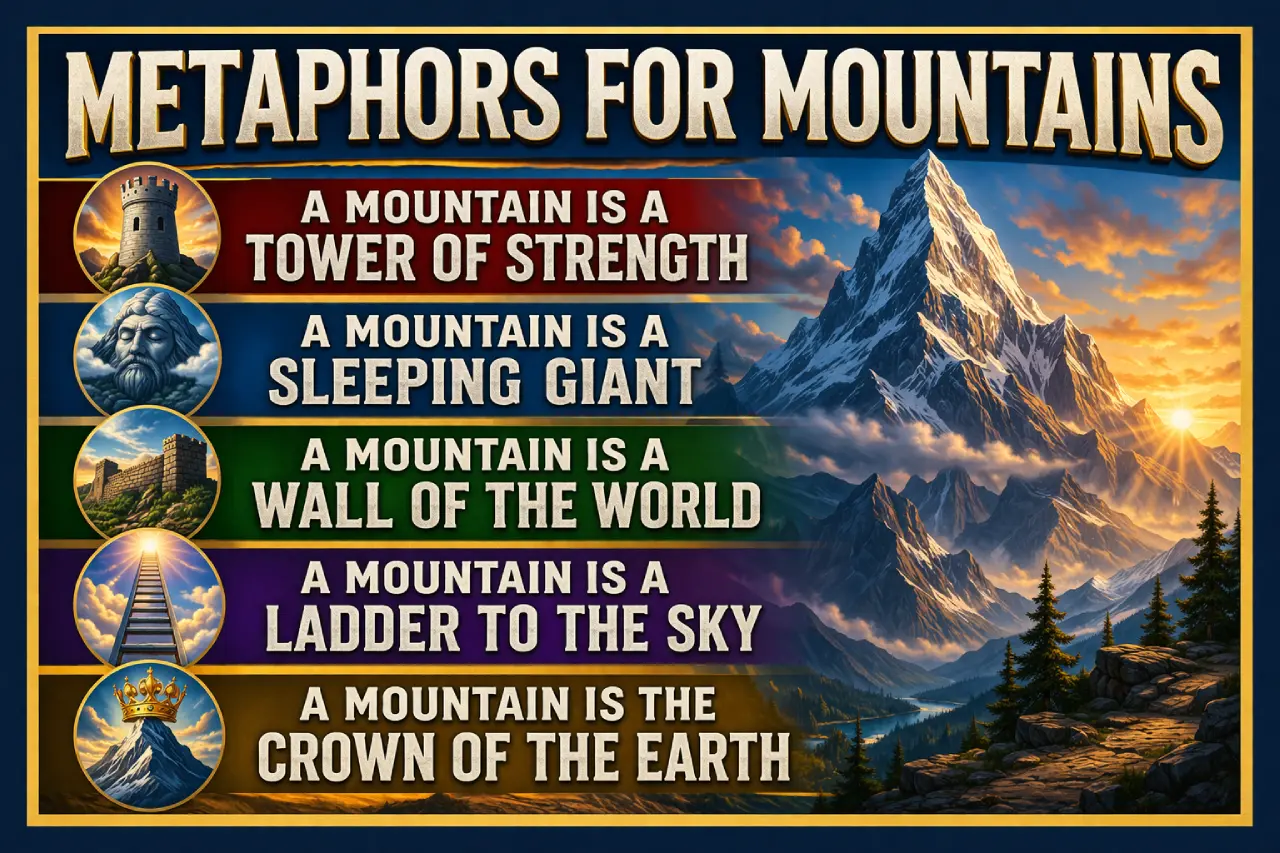
1. A Mountain Is a Tower of Strength
Meaning: A mountain represents stability, endurance, and unshakable strength.
In a Sentence: During the crisis, her leadership stood like a tower of strength for the entire team.
Other Ways to Say: A pillar of strength, a rock of stability, an immovable force
Why It Works: Mountains appear massive and unmoving, making them a natural symbol of resilience.
Best Used For: Describing dependable people, strong leaders, or emotional resilience.
2. A Mountain Is a Sleeping Giant
Meaning: A mountain symbolizes hidden power or quiet potential.
In a Sentence: The dormant volcano rested like a sleeping giant beneath the clouds.
Other Ways to Say: A silent titan, a resting giant, a quiet powerhouse
Why It Works: Mountains often appear calm but contain enormous geological power.
Best Used For: Dramatic storytelling, nature writing, or describing untapped potential.
3. A Mountain Is a Wall of the World
Meaning: A mountain represents a barrier or massive obstacle.
In a Sentence: The towering cliffs formed a wall of the world between the two valleys.
Other Ways to Say: A natural barrier, a towering wall, a massive blockade
Why It Works: Mountains physically divide regions and stop movement.
Best Used For: Describing major challenges or geographical obstacles.
4. A Mountain Is a Ladder to the Sky
Meaning: A mountain symbolizes ambition and the pursuit of high goals.
In a Sentence: To the young climber, the peak looked like a ladder to the sky.
Other Ways to Say: A stairway to the sky, a path upward, a climb to greatness
Why It Works: Mountains rise toward the clouds, visually suggesting upward progress.
Best Used For: Motivational writing and personal growth topics.
5. A Mountain Is the Crown of the Earth
Meaning: A mountain represents grandeur, beauty, and natural majesty.
In a Sentence: The snow-covered summit gleamed like the crown of the earth at sunrise.
Other Ways to Say: A jewel of the land, a royal peak, a natural crown
Why It Works: Peaks sit at the highest point of landscapes, like crowns above heads.
Best Used For: Scenic descriptions and travel writing.
6. A Mountain Is a Test of Courage
Meaning: A mountain symbolizes a challenge that requires bravery.
In a Sentence: Starting a new career felt like facing a test of courage as tall as a mountain.
Other Ways to Say: A trial of strength, a climb of bravery, a daring challenge
Why It Works: Climbing mountains requires determination and courage.
Best Used For: Inspirational or motivational content.
7. A Mountain Is a Silent Teacher
Meaning: A mountain represents wisdom and patience.
In a Sentence: Spending time among the peaks felt like learning from a silent teacher.
Other Ways to Say: A quiet mentor, a patient guide, a natural philosopher
Why It Works: Mountains exist for centuries, symbolizing enduring wisdom.
Best Used For: Reflective writing or philosophical discussions.
8. A Mountain Is a Fortress of Stone
Meaning: A mountain symbolizes protection and defense.
In a Sentence: The rugged cliffs stood like a fortress of stone guarding the valley.
Other Ways to Say: A stone stronghold, a natural fortress, a defensive wall
Why It Works: Mountains resemble enormous defensive structures.
Best Used For: Describing safety, strength, or protection.
9. A Mountain Is a Staircase of Dreams
Meaning: A mountain symbolizes gradual progress toward success.
In a Sentence: Each small achievement felt like another step on a staircase of dreams.
Other Ways to Say: A ladder of ambition, steps to success
Why It Works: Climbing a mountain happens one step at a time.
Best Used For: Personal development writing.
10. A Mountain Is the Backbone of the Land
Meaning: A mountain represents the structural core of a landscape.
In a Sentence: The Rocky Mountains form the backbone of the American West.
Other Ways to Say: The spine of the land, the framework of nature
Why It Works: Mountain ranges shape ecosystems and geography.
Best Used For: Geography and environmental writing.
11. A Mountain Is a Giant’s Throne
Meaning: A mountain symbolizes dominance and authority.
In a Sentence: The peak rose like a giant’s throne overlooking the valley.
Other Ways to Say: A ruler’s seat, a summit throne
Why It Works: Mountains dominate the landscape from above.
Best Used For: Epic storytelling and dramatic imagery.
12. A Mountain Is a Beacon of the Horizon
Meaning: A mountain represents guidance or direction.
In a Sentence: The distant peak became a beacon of the horizon for the hikers.
Other Ways to Say: A guiding landmark, a visible anchor
Why It Works: Mountains can be seen from far away and guide travelers.
Best Used For: Travel stories and adventure writing.
13. A Mountain Is a Monument of Time
Meaning: A mountain symbolizes ancient endurance.
In a Sentence: The granite peak stood as a monument of time.
Other Ways to Say: A timeless landmark, an ancient witness
Why It Works: Mountains form over millions of years.
Best Used For: Historical or geological writing.
14. A Mountain Is a Giant Guardian
Meaning: A mountain represents protection and watchfulness.
In a Sentence: The snowy peaks acted as giant guardians of the valley.
Other Ways to Say: A watchful protector, a natural sentinel
Why It Works: Mountains often surround and shelter valleys.
Best Used For: Nature writing and scenic descriptions.
15. A Mountain Is a Wall of Challenge
Meaning: A mountain symbolizes a difficult obstacle.
In a Sentence: Learning a new language felt like facing a wall of challenge.
Other Ways to Say: A towering obstacle, a huge barrier
Why It Works: Mountains represent something difficult to overcome.
Best Used For: Discussing challenges and perseverance.
16. A Mountain Is a Crown of Ice
Meaning: A mountain symbolizes majestic beauty.
In a Sentence: The glacier-covered summit shone like a crown of ice.
Other Ways to Say: A frozen crown, a snowy jewel
Why It Works: Snowy peaks resemble sparkling crowns.
Best Used For: Describing winter landscapes.
17. A Mountain Is a Bridge to the Clouds
Meaning: A mountain represents connection between earth and sky.
In a Sentence: The summit looked like a bridge to the clouds.
Other Ways to Say: A stairway to the clouds, a sky bridge
Why It Works: High peaks reach into cloud layers.
Best Used For: Poetic or inspirational writing.
18. A Mountain Is a Silent King
Meaning: A mountain symbolizes quiet authority.
In a Sentence: The tallest peak ruled the valley like a silent king.
Other Ways to Say: A stone monarch, a natural ruler
Why It Works: Height suggests leadership and dominance.
Best Used For: Dramatic or descriptive writing.
19. A Mountain Is a Wall of Patience
Meaning: A mountain represents endurance through time.
In a Sentence: The cliffs stood like a wall of patience against the wind.
Other Ways to Say: Endless endurance, steady resilience
Why It Works: Mountains remain unchanged for centuries.
Best Used For: Reflective writing about patience.
20. A Mountain Is a Lighthouse of Stone
Meaning: A mountain symbolizes guidance.
In a Sentence: The peak acted like a lighthouse of stone guiding travelers.
Other Ways to Say: A guiding landmark, a visible compass
Why It Works: Tall mountains are visible from long distances.
Best Used For: Adventure and exploration stories.
21. A Mountain Is a Throne of the Sky
Meaning: A mountain symbolizes elevation and greatness.
In a Sentence: The summit looked like a throne of the sky.
Other Ways to Say: A heavenly throne, a sky seat
Why It Works: Peaks sit high above the land.
Best Used For: Epic descriptions and poetry.
22. A Mountain Is a Giant Staircase
Meaning: A mountain represents gradual effort and progress.
In a Sentence: The winding path felt like climbing a giant staircase.
Other Ways to Say: A stairway upward, steps to greatness
Why It Works: Mountain trails rise step by step.
Best Used For: Motivational writing.
23. A Mountain Is a Cathedral of Stone
Meaning: A mountain symbolizes sacred beauty and awe.
In a Sentence: The cliffs rose like a cathedral of stone.
Other Ways to Say: A natural temple, a sacred monument
Why It Works: Tall rock formations resemble cathedral architecture.
Best Used For: Nature writing and scenic descriptions.
24. A Mountain Is a Wall of Courage
Meaning: A mountain symbolizes bravery.
In a Sentence: Facing the competition felt like climbing a wall of courage.
Other Ways to Say: A test of bravery, a daring challenge
Why It Works: Overcoming mountains requires determination.
Best Used For: Personal growth writing.
25. A Mountain Is a Shield of the Earth
Meaning: A mountain represents protection from harm.
In a Sentence: The mountains acted as a shield of the earth against storms.
Other Ways to Say: A protective barrier, a natural shield
Why It Works: Mountains block wind and weather.
Best Used For: Environmental writing.
26. A Mountain Is a King of the Landscape
Meaning: A mountain symbolizes dominance in nature.
In a Sentence: The tallest peak stood as the king of the landscape.
Other Ways to Say: A natural monarch, a ruling summit
Why It Works: Height creates visual authority.
Best Used For: Describing prominent landmarks.
27. A Mountain Is a Tower of Silence
Meaning: A mountain represents peaceful solitude.
In a Sentence: The remote peak felt like a tower of silence.
Other Ways to Say: A quiet giant, a peaceful monument
Why It Works: Mountains often exist far from human noise.
Best Used For: Meditation or reflective writing.
28. A Mountain Is a Crown of the Horizon
Meaning: A mountain symbolizes the highest visible feature.
In a Sentence: The summit appeared like a crown of the horizon at sunset.
Other Ways to Say: A skyline jewel, a horizon crown
Why It Works: Mountains dominate the skyline.
Best Used For: Descriptive landscape writing.
29. A Mountain Is a Stone Ocean Wave
Meaning: A mountain symbolizes frozen motion in nature.
In a Sentence: The range looked like a giant stone ocean wave.
Other Ways to Say: A frozen wave, a solid surge
Why It Works: Mountain ridges often resemble waves.
Best Used For: Creative descriptions.
30. A Mountain Is a Ladder of Determination
Meaning: A mountain represents persistence toward goals.
In a Sentence: Finishing the project felt like climbing a ladder of determination.
Other Ways to Say: A climb to success, a stairway of effort
Why It Works: Climbing mountains requires persistence.
Best Used For: Inspirational writing.
31. A Mountain Is a Wall of Time
Meaning: A mountain symbolizes deep history.
In a Sentence: The cliffs looked like a wall of time.
Other Ways to Say: A monument of ages, a geological record
Why It Works: Mountains reveal layers of history.
Best Used For: Historical or geological discussions.
32. A Mountain Is a Giant’s Shoulder
Meaning: A mountain represents strength and support.
In a Sentence: The ridge looked like the shoulder of a giant holding up the sky.
Other Ways to Say: A massive support, a giant backbone
Why It Works: The shape of ridges resembles shoulders.
Best Used For: Dramatic landscape descriptions.
33. A Mountain Is a Symbol of Endless Possibility
Meaning: A mountain symbolizes goals waiting to be achieved.
In a Sentence: Every challenge in life can become a mountain of possibility.
Other Ways to Say: A peak of opportunity, a climb toward dreams
Why It Works: Mountains represent both challenge and achievement.
Best Used For: Motivational writing and personal development.
How to Use Mountain Metaphors in Writing
Mountain metaphors work well because they combine strong imagery with emotional meaning. They can represent obstacles, achievements, patience, ambition, and wisdom.
Writers commonly use mountain metaphors in:
- Motivational speeches
- Personal development articles
- Poetry and storytelling
- Travel writing
When used thoughtfully, these metaphors help readers picture the scale and emotion of a situation more clearly.
Final Thoughts
Mountains remind us that the biggest achievements often require patience, persistence, and courage. The 33 metaphors for mountains in this guide show how one powerful natural image can represent strength, obstacles, wisdom, ambition, and perseverance.
If you’re interested in exploring additional examples of nature-based metaphors, you can also review collections like the one available on Idioms for All to see how mountain imagery is used across different writing styles.
Now here’s a simple question for you: Which of these metaphors best describes your current journey—a ladder to the sky, a wall of courage, or a sleeping giant waiting to awaken?