Death is one of the most sensitive and profound topics in human experience, and because of that, people rarely describe it directly. Instead, writers, poets, and everyday speakers often rely on metaphors to talk about death in a softer, symbolic, or more reflective way. These metaphors help express emotions, beliefs, and ideas about life’s final moment without using blunt language.
If you’re looking for a quick answer, metaphors for death are figurative expressions that describe death by comparing it to journeys, sleep, fading light, or transitions to another place.
In this article, I’ve gathered 49 metaphors for death that commonly appear in literature, conversations, and storytelling. Each metaphor includes its meaning, a clear one-line sentence example, alternative ways to express the idea, and two additional notes explaining when and how the metaphor is typically used.
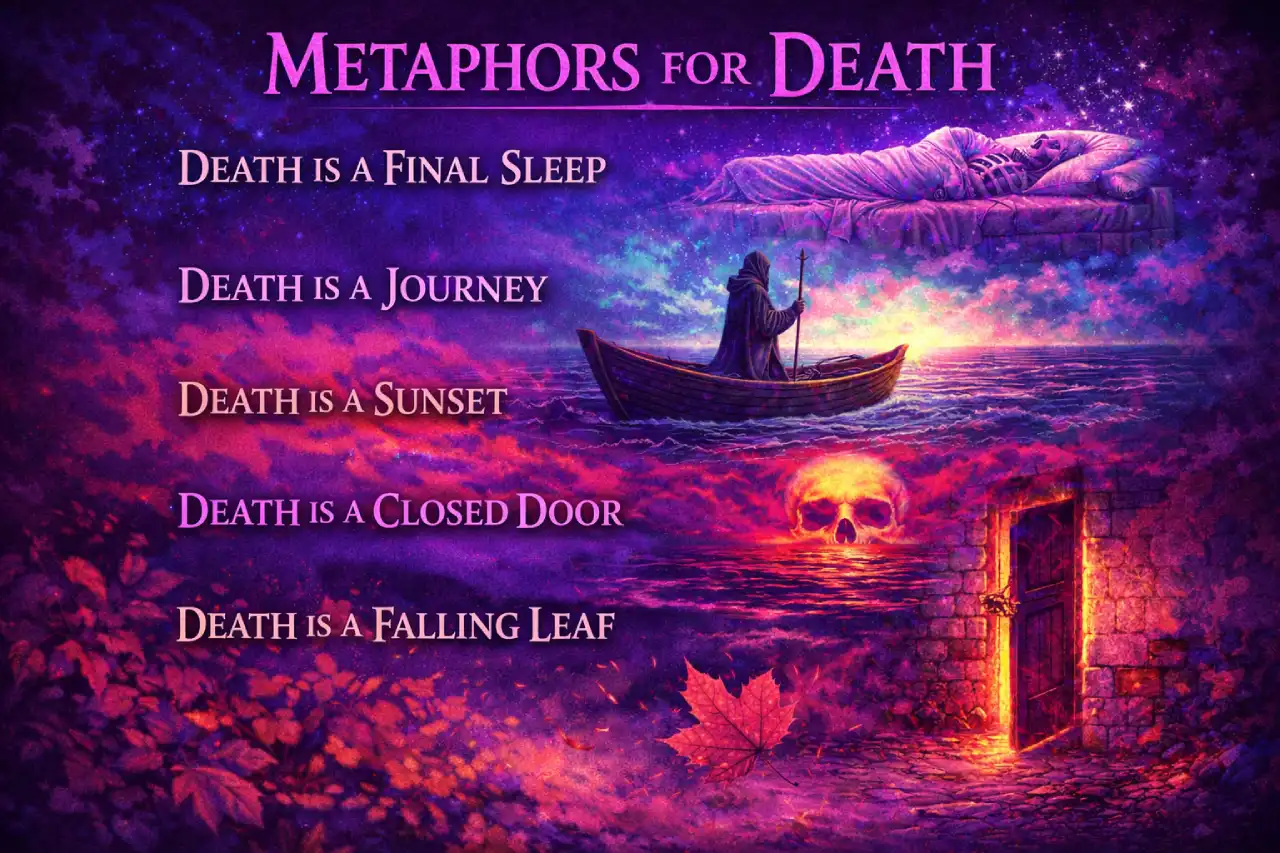
1. Death Is a Final Sleep

Meaning: Death is compared to a peaceful rest.
In a Sentence: After a long life, he entered the final sleep.
Other Ways to Say: Eternal rest, peaceful sleep
When to Use It: Gentle or comforting descriptions
Tone or Context: Soft and reflective
2. Death Is a Journey
Meaning: Death is seen as traveling to another place.
In a Sentence: Many cultures describe death as the beginning of a journey.
Other Ways to Say: Final passage, last voyage
When to Use It: Spiritual or philosophical discussions
Tone or Context: Thoughtful
3. Death Is a Sunset

Meaning: Death marks the closing of life just as sunset ends the day.
In a Sentence: His life reached its sunset after decades of wisdom.
Other Ways to Say: Life’s closing moment
When to Use It: Reflective storytelling
Tone or Context: Poetic
4. Death Is a Closed Door
Meaning: Death represents the end of life’s opportunities.
In a Sentence: For many, death feels like a door quietly closing.
Other Ways to Say: Life’s ending
When to Use It: Philosophical reflections
Tone or Context: Serious
5. Death Is a Falling Leaf

Meaning: Life naturally ends as leaves fall from trees.
In a Sentence: In autumn, a falling leaf often symbolizes death.
Other Ways to Say: Natural ending
When to Use It: Poetic writing
Tone or Context: Gentle
6. Death Is a Silent Night
Meaning: Death represents quietness and stillness.
In a Sentence: His passing felt like a silent night settling in.
Other Ways to Say: Eternal quiet
When to Use It: Emotional reflection
Tone or Context: Calm
7. Death Is the Last Chapter

Meaning: Life is like a story that ends with a final chapter.
In a Sentence: Every life eventually reaches its last chapter.
Other Ways to Say: Final part of life
When to Use It: Reflecting on life stories
Tone or Context: Thoughtful
8. Death Is a Dark Horizon
Meaning: Death is the unknown beyond life.
In a Sentence: Many see death as a dark horizon ahead.
Other Ways to Say: Unknown future
When to Use It: Philosophical discussions
Tone or Context: Reflective
9. Death Is a Vanishing Star
Meaning: Life fades like a star disappearing in the sky.
In a Sentence: His life faded like a vanishing star.
Other Ways to Say: Gradual fading
When to Use It: Poetic writing
Tone or Context: Emotional
10. Death Is the Final Curtain
Meaning: Life ends like a play concluding on stage.
In a Sentence: For the actor, death felt like the final curtain.
Other Ways to Say: Life’s closing act
When to Use It: Artistic discussions
Tone or Context: Dramatic
11. Death Is a Long Goodbye
Meaning: Death is seen as a permanent farewell.
In a Sentence: For the family, the moment felt like a long goodbye.
Other Ways to Say: Last farewell
When to Use It: Emotional contexts
Tone or Context: Reflective
12. Death Is a Quiet River
Meaning: Death carries life away peacefully.
In a Sentence: Some imagine death as crossing a quiet river.
Other Ways to Say: Final crossing
When to Use It: Spiritual imagery
Tone or Context: Calm
13. Death Is a Fading Light

Meaning: Life slowly disappears like dimming light.
In a Sentence: His energy faded like a dimming light.
Other Ways to Say: Life fading away
When to Use It: Emotional storytelling
Tone or Context: Poetic
14. Death Is a Shadow
Meaning: Death quietly follows life.
In a Sentence: In many stories, death is portrayed as a shadow.
Other Ways to Say: Inevitable ending
When to Use It: Literary discussions
Tone or Context: Dramatic
15. Death Is a Closed Book
Meaning: Life’s story has ended.
In a Sentence: With his passing, a remarkable life became a closed book.
Other Ways to Say: End of life story
When to Use It: Reflective writing
Tone or Context: Thoughtful
16. Death Is a Doorway
Meaning: Death leads to another existence.
In a Sentence: Some traditions describe death as a doorway.
Other Ways to Say: Transition
When to Use It: Spiritual contexts
Tone or Context: Hopeful
17. Death Is a Silent Clock
Meaning: Time for someone has stopped.
In a Sentence: When he passed away, it felt like a silent clock.
Other Ways to Say: Time stopped
When to Use It: Emotional reflection
Tone or Context: Serious
18. Death Is a Sleeping Forest
Meaning: Death brings stillness and calm.
In a Sentence: The cemetery looked like a sleeping forest.
Other Ways to Say: Quiet rest
When to Use It: Poetic descriptions
Tone or Context: Calm
19. Death Is a Broken Hourglass
Meaning: Life’s time has run out.
In a Sentence: His passing felt like a broken hourglass.
Other Ways to Say: Time expired
When to Use It: Philosophical contexts
Tone or Context: Serious
20. Death Is a Passing Cloud
Meaning: Life disappears quickly.
In a Sentence: His years felt like a passing cloud.
Other Ways to Say: Brief life
When to Use It: Reflective writing
Tone or Context: Poetic
21. Death Is a Quiet Departure
Meaning: Someone leaves life peacefully.
In a Sentence: She made a quiet departure from the world.
Other Ways to Say: Peaceful passing
When to Use It: Gentle conversations
Tone or Context: Respectful
22. Death Is a Distant Shore
Meaning: Death is a place beyond life.
In a Sentence: Sailors often describe death as reaching a distant shore.
Other Ways to Say: Final destination
When to Use It: Spiritual reflections
Tone or Context: Poetic
23. Death Is a Dark Doorway
Meaning: Death leads to the unknown.
In a Sentence: Some see death as stepping through a dark doorway.
Other Ways to Say: Unknown transition
When to Use It: Philosophical discussion
Tone or Context: Reflective
24. Death Is a Whispering Wind
Meaning: Death arrives quietly.
In a Sentence: In many poems, death is a whispering wind.
Other Ways to Say: Quiet passing
When to Use It: Literary contexts
Tone or Context: Poetic
25. Death Is a Still Ocean
Meaning: Death represents calm silence.
In a Sentence: His passing felt like the calm of a still ocean.
Other Ways to Say: Eternal calm
When to Use It: Reflective writing
Tone or Context: Peaceful
26. Death Is a Broken Candle
Meaning: Life’s flame has gone out.
In a Sentence: His life ended like a broken candle.
Other Ways to Say: Life extinguished
When to Use It: Emotional contexts
Tone or Context: Symbolic
27. Death Is a Closing Gate
Meaning: Life has reached its final boundary.
In a Sentence: For some, death feels like a closing gate.
Other Ways to Say: Final barrier
When to Use It: Philosophical reflections
Tone or Context: Serious
28. Death Is a Sleeping Star
Meaning: Life fades quietly into darkness.
In a Sentence: Her memory shines like a sleeping star.
Other Ways to Say: Quiet fading
When to Use It: Poetic writing
Tone or Context: Emotional
29. Death Is a Last Breath

Meaning: Life ends with the final breath.
In a Sentence: His last breath marked the end of a long life.
Other Ways to Say: Final moment
When to Use It: Medical or emotional contexts
Tone or Context: Serious
30. Death Is a Final Journey
Meaning: Death is life’s ultimate travel.
In a Sentence: Many traditions call death the final journey.
Other Ways to Say: Last voyage
When to Use It: Cultural discussions
Tone or Context: Reflective
31. Death Is a Dark Sleep
Meaning: Death resembles endless sleep.
In a Sentence: In literature, death is often called a dark sleep.
Other Ways to Say: Eternal sleep
When to Use It: Poetic writing
Tone or Context: Gentle
32. Death Is a Fallen Tree
Meaning: A life once strong has ended.
In a Sentence: The old leader’s passing felt like a fallen tree.
Other Ways to Say: Loss of strength
When to Use It: Symbolic storytelling
Tone or Context: Reflective
33. Death Is a Quiet Harbor
Meaning: Death is a place of rest after life’s storms.
In a Sentence: Some imagine death as a quiet harbor.
Other Ways to Say: Final peace
When to Use It: Spiritual contexts
Tone or Context: Calm
34. Death Is a Broken Bridge
Meaning: The connection to life has ended.
In a Sentence: Death can feel like crossing a broken bridge.
Other Ways to Say: End of connection
When to Use It: Emotional reflection
Tone or Context: Dramatic
35. Death Is a Silent Bell
Meaning: Life’s signal has ended.
In a Sentence: His death echoed like a silent bell.
Other Ways to Say: End of presence
When to Use It: Literary writing
Tone or Context: Poetic
36. Death Is a Lost Horizon
Meaning: Life disappears into the unknown.
In a Sentence: His life vanished like a lost horizon.
Other Ways to Say: Unknown beyond
When to Use It: Reflective discussions
Tone or Context: Thoughtful
37. Death Is a Final Whisper
Meaning: Life ends quietly.
In a Sentence: Her last moments felt like a final whisper.
Other Ways to Say: Quiet passing
When to Use It: Emotional contexts
Tone or Context: Gentle
38. Death Is a Dark River
Meaning: Death carries life away.
In a Sentence: In mythology, souls cross a dark river.
Other Ways to Say: Spiritual crossing
When to Use It: Cultural discussions
Tone or Context: Symbolic
39. Death Is a Silent Path

Meaning: Death leads quietly to another state.
In a Sentence: Many see death as walking a silent path.
Other Ways to Say: Quiet transition
When to Use It: Philosophical writing
Tone or Context: Reflective
40. Death Is a Fading Song
Meaning: Life slowly disappears like music ending.
In a Sentence: His life ended like a fading song.
Other Ways to Say: Gradual ending
When to Use It: Poetic contexts
Tone or Context: Emotional
41. Death Is a Dark Horizon Line
Meaning: Death lies beyond life’s visible limits.
In a Sentence: Life eventually reaches a dark horizon line.
Other Ways to Say: Life boundary
When to Use It: Philosophical reflections
Tone or Context: Serious
42. Death Is a Sleeping Flame
Meaning: Life’s energy has quietly stopped.
In a Sentence: The candle burned out like a sleeping flame.
Other Ways to Say: Extinguished life
When to Use It: Symbolic writing
Tone or Context: Gentle
43. Death Is a Closed Curtain
Meaning: Life’s performance has ended.
In a Sentence: His passing felt like a curtain closing.
Other Ways to Say: End of life stage
When to Use It: Dramatic or artistic contexts
Tone or Context: Reflective
44. Death Is a Quiet Valley
Meaning: Death brings deep stillness.
In a Sentence: Some poems describe death as entering a quiet valley.
Other Ways to Say: Silent resting place
When to Use It: Spiritual writing
Tone or Context: Peaceful
45. Death Is a Broken Compass
Meaning: Life’s direction has ended.
In a Sentence: Without him, it felt like a broken compass.
Other Ways to Say: Lost guidance
When to Use It: Emotional contexts
Tone or Context: Reflective
46. Death Is a Final Sunset

Meaning: Life ends as day fades into night.
In a Sentence: His final years felt like a sunset slowly fading.
Other Ways to Say: End of life
When to Use It: Poetic writing
Tone or Context: Gentle
47. Death Is a Silent Horizon
Meaning: Death is a quiet unknown boundary.
In a Sentence: Many see death waiting beyond a silent horizon.
Other Ways to Say: Unknown beyond life
When to Use It: Philosophical writing
Tone or Context: Reflective
48. Death Is a Resting Harbor
Meaning: Death brings peace after life’s struggles.
In a Sentence: After suffering, death became a resting harbor.
Other Ways to Say: Eternal peace
When to Use It: Comforting contexts
Tone or Context: Gentle
49. Death Is a Quiet Ending
Meaning: Death marks the peaceful conclusion of life.
In a Sentence: His passing felt like a quiet ending to a long story.
Other Ways to Say: Life’s conclusion
When to Use It: Reflective writing
Tone or Context: Respectful
Conclusion
Metaphors for death help people talk about one of life’s most sensitive topics in a thoughtful and symbolic way. Instead of describing death directly, these expressions allow writers and speakers to communicate emotions, beliefs, and reflections about life’s ending with more depth and sensitivity.
Personally, I’ve always noticed that metaphors soften difficult conversations while also giving readers powerful imagery to understand the meaning behind life’s final transition.
If you found this article informative, feel free to check out our other articles as well.