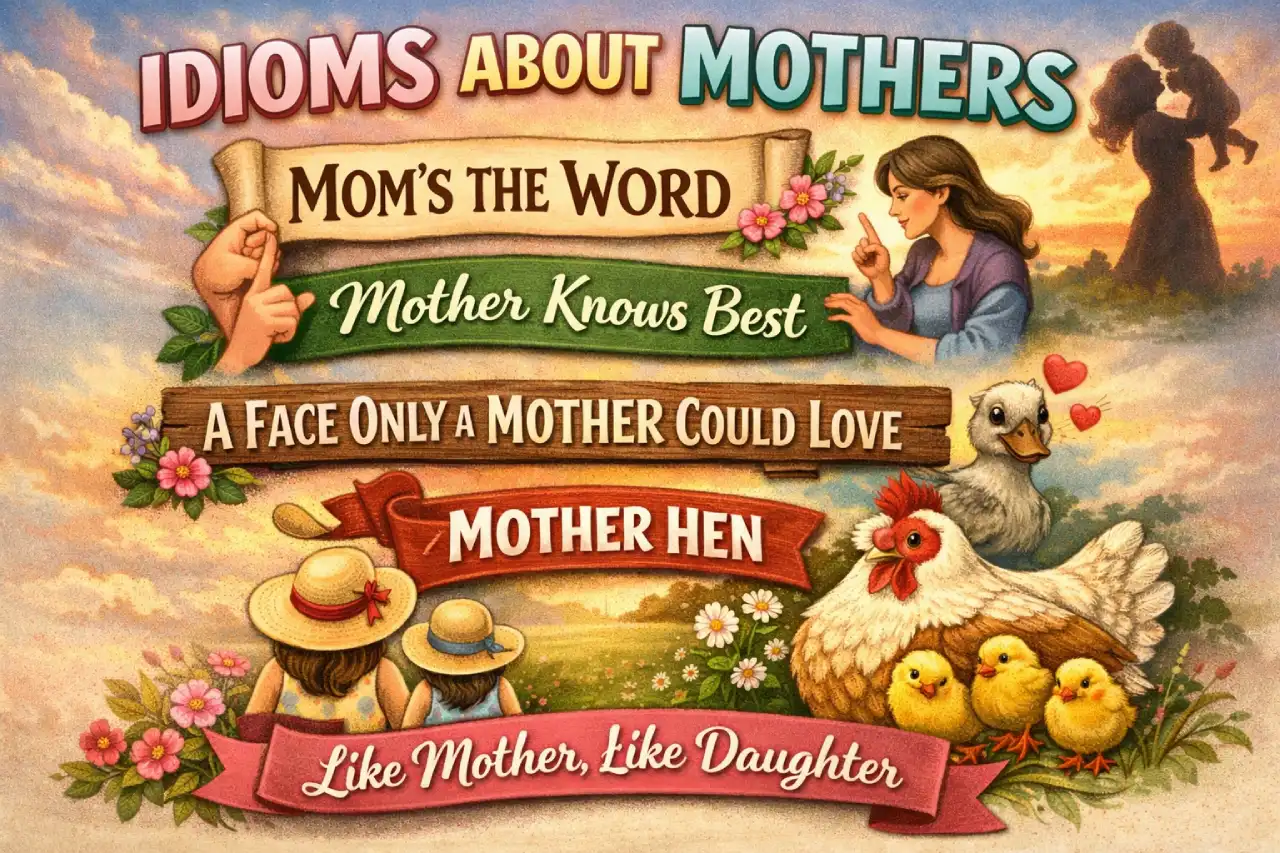
Mothers play an important role in language as well as in life. Over the years, English speakers have created many idioms and expressions that revolve around mothers, motherhood, and family relationships. These idioms appear in conversations, literature, and even news writing because they help describe emotions, personality traits, and family dynamics in a colorful way.
In this article, I’ve gathered 39 idioms related to mothers and explained them in a simple and practical way. If you are learning English or writing creatively, these phrases can help you express ideas more naturally. Each idiom includes its meaning, a one-line example sentence, alternative expressions, and a few helpful notes to make the phrase easier to understand and use.
Why Idioms About Mothers Are So Common
Language often reflects social values. Since mothers are commonly associated with care, guidance, protection, and sacrifice, many idioms use maternal imagery to describe these qualities. Some expressions highlight nurturing behavior, while others focus on family resemblance or upbringing.
Learning these idioms can help you understand everyday English more clearly and make your own writing sound more natural.
1. Mom’s the Word
Meaning: Keep something secret.
In a Sentence: I know the surprise party details, but don’t worry—mom’s the word.
Other Ways to Say: Keep it quiet, stay silent, not a word.
Usage Tip: Often used humorously when promising secrecy.
Note: The phrase does not literally refer to mothers; it simply means silence.
2. Mother Knows Best

Meaning: Mothers usually give wise advice.
In a Sentence: I ignored her advice at first, but it turned out mother knows best.
Other Ways to Say: Parents know better, wise guidance, trusted advice.
Usage Tip: Used when parental advice proves correct.
Note: Common in family conversations.
3. A Face Only a Mother Could Love

Meaning: Someone who is not considered attractive but is loved anyway.
In a Sentence: He joked that his messy haircut gave him a face only a mother could love.
Other Ways to Say: Unconventional appearance, uniquely charming.
Usage Tip: Usually said jokingly.
Note: Emphasizes unconditional love.
4. Mother Hen

Meaning: Someone who is overly protective.
In a Sentence: My sister acts like a mother hen whenever I travel alone.
Other Ways to Say: Overprotective guardian, constant worrier.
Usage Tip: Often used for caring personalities.
Note: Inspired by hens protecting their chicks.
5. Like Mother, Like Daughter

Meaning: A daughter behaves like her mother.
In a Sentence: Both of them love gardening—like mother, like daughter.
Other Ways to Say: Family resemblance, runs in the family.
Usage Tip: Can refer to personality or habits.
Note: Similar phrase: “Like father, like son.”
6. At One’s Mother’s Knee
Meaning: Learning something during childhood.
In a Sentence: She learned traditional recipes at her mother’s knee.
Other Ways to Say: Learned early in life, childhood lessons.
Usage Tip: Often used when discussing values or traditions.
Note: Refers to learning while sitting beside a parent.
7. Mother of All Battles

Meaning: The biggest or most important event of its kind.
In a Sentence: The championship match was called the mother of all battles.
Other Ways to Say: Ultimate showdown, biggest challenge.
Usage Tip: Often used dramatically in media.
Note: Popularized in political speeches.
8. Mama’s Boy

Meaning: A man overly dependent on his mother.
In a Sentence: His friends tease him for being a mama’s boy.
Other Ways to Say: Overly attached son, dependent adult.
Usage Tip: Can be playful or critical.
Note: Common in casual speech.
9. Mother Nature

Meaning: Nature personified as a nurturing force.
In a Sentence: Mother Nature surprised everyone with heavy rain in summer.
Other Ways to Say: The natural world, the environment.
Usage Tip: Used when discussing weather or ecology.
Note: A symbolic figure in many cultures.
10. Mother Tongue

Meaning: A person’s first language.
In a Sentence: Bengali is his mother tongue.
Other Ways to Say: Native language, first language.
Usage Tip: Common in academic and cultural discussions.
Note: Highlights the language learned in childhood.
11. Necessity Is the Mother of Invention
Meaning: Difficult situations inspire creative solutions.
In a Sentence: When the machine broke, necessity became the mother of invention.
Other Ways to Say: Innovation from need, creative problem solving.
Usage Tip: Used when new ideas emerge from challenges.
Note: A very old proverb.
12. Mother Figure
Meaning: Someone who acts like a mother emotionally.
In a Sentence: The teacher became a mother figure to many students.
Other Ways to Say: Caregiver, mentor, protector.
Usage Tip: Used when someone provides emotional support.
Note: Not necessarily a biological mother.
13. Tiger Mother

Meaning: A strict parent focused on success.
In a Sentence: Her tiger mother insisted she practice piano every day.
Other Ways to Say: Strict parent, demanding guardian.
Usage Tip: Often used in discussions about education.
Note: Popularized in modern parenting debates.
14. Earth Mother
Meaning: A nurturing and nature-loving woman.
In a Sentence: She’s known as the earth mother of the community garden.
Other Ways to Say: Natural caretaker, nurturing personality.
Usage Tip: Often used affectionately.
Note: Associated with environmental awareness.
15. Mother Lode
Meaning: A rich source of something valuable.
In a Sentence: The researcher discovered the mother lode of historical records.
Other Ways to Say: Major discovery, treasure trove.
Usage Tip: Used for large discoveries.
Note: Originally a mining term.
16. Mother Ship

Meaning: A main base or controlling center.
In a Sentence: The drones returned to the mother ship after completing the task.
Other Ways to Say: Main base, central hub.
Usage Tip: Common in technology or science fiction.
Note: Used metaphorically.
17. A Mother’s Touch
Meaning: Careful and loving attention.
In a Sentence: The home felt warm and organized thanks to her mother’s touch.
Other Ways to Say: Gentle care, nurturing influence.
Usage Tip: Often used in home or family contexts.
Note: Highlights nurturing qualities.
18. Mother of Invention
Meaning: The source of creativity.
In a Sentence: Resource shortages became the mother of invention for the team.
Other Ways to Say: Source of innovation.
Usage Tip: Used in discussions of creativity.
Note: Often shortened from the full proverb.
19. Mother Country
Meaning: One’s homeland.
In a Sentence: Many immigrants still feel connected to their mother country.
Other Ways to Say: Homeland, native land.
Usage Tip: Used in historical or cultural contexts.
Note: Often used in colonial history.
20. Mother Load of Problems
Meaning: A large number of difficulties.
In a Sentence: The company faced the mother load of problems after the system crash.
Other Ways to Say: Huge trouble, overwhelming issues.
Usage Tip: Used informally.
Note: Emphasizes scale.
21. Mother Bear
Meaning: A fiercely protective parent.
In a Sentence: She turned into a mother bear when someone criticized her child.
Other Ways to Say: Fierce protector, defensive parent.
Usage Tip: Used for strong parental defense.
Note: Inspired by animal behavior.
22. Motherly Advice
Meaning: Caring and wise guidance.
In a Sentence: Her motherly advice helped me handle the situation calmly.
Other Ways to Say: Warm guidance, gentle suggestion.
Usage Tip: Often comforting in tone.
Note: Reflects trust and experience.
23. Mother of Dragons (figurative)
Meaning: A powerful female leader.
In a Sentence: Fans called her the mother of dragons for leading the team confidently.
Other Ways to Say: Strong leader, fearless woman.
Usage Tip: Used metaphorically.
Note: Popularized by modern fiction.
24. Mother Earth
Meaning: The planet seen as a life-giving force.
In a Sentence: Protecting forests means protecting Mother Earth.
Other Ways to Say: The planet, nature itself.
Usage Tip: Common in environmental discussions.
Note: Found in many cultures.
25. Mother Instinct
Meaning: Natural protective feelings.
In a Sentence: Her mother instinct told her something was wrong.
Other Ways to Say: Protective instinct, parental intuition.
Usage Tip: Used when sensing danger or need.
Note: Often discussed in psychology.
26. Mother of All Ideas

Meaning: A groundbreaking idea.
In a Sentence: The startup founder called it the mother of all ideas.
Other Ways to Say: Revolutionary idea, big concept.
Usage Tip: Used enthusiastically.
Note: Inspired by similar dramatic idioms.
27. Mother’s Pride
Meaning: Something that makes a mother proud.
In a Sentence: Graduating with honors became his mother’s pride.
Other Ways to Say: Source of pride, proud achievement.
Usage Tip: Used in emotional contexts.
Note: Often used in family stories.
28. Mother of All Storms
Meaning: An extremely powerful storm.
In a Sentence: Meteorologists warned of the mother of all storms approaching the coast.
Other Ways to Say: Massive storm, severe weather.
Usage Tip: Used dramatically in news.
Note: Emphasizes intensity.
29. Mother’s Blessing

Meaning: Approval or support from a mother.
In a Sentence: He felt confident starting his business with his mother’s blessing.
Other Ways to Say: Family approval, parental support.
Usage Tip: Often used in emotional contexts.
Note: Important in many cultures.
30. Mother’s Love
Meaning: Deep unconditional love.
In a Sentence: A mother’s love often stays strong through every challenge.
Other Ways to Say: Unconditional love, lifelong care.
Usage Tip: Used in emotional writing.
Note: A universal theme.
31. Mother of the House
Meaning: The woman who manages household affairs.
In a Sentence: Everyone respected her as the mother of the house.
Other Ways to Say: Head of the household, homemaker.
Usage Tip: Used in traditional contexts.
Note: Reflects family roles.
32. Mother Figure in the Office
Meaning: Someone who cares for coworkers like a parent.
In a Sentence: The senior manager became a mother figure in the office.
Other Ways to Say: Workplace mentor, caring leader.
Usage Tip: Often said respectfully.
Note: Common in workplace culture.
33. Mother’s Wisdom

Meaning: Practical life advice from experience.
In a Sentence: I remembered my mother’s wisdom during the difficult decision.
Other Ways to Say: Practical advice, life lessons.
Usage Tip: Often reflective.
Note: Used in storytelling.
34. Mother’s Heart
Meaning: A caring and compassionate personality.
In a Sentence: Her mother’s heart made her volunteer for community work.
Other Ways to Say: Kind soul, compassionate nature.
Usage Tip: Used for emotional descriptions.
Note: Highlights empathy.
35. Mother of All Discoveries
Meaning: A discovery with huge impact.
In a Sentence: Scientists called it the mother of all discoveries in medicine.
Other Ways to Say: Historic breakthrough.
Usage Tip: Often used in media headlines.
Note: Emphasizes significance.
36. Motherly Care

Meaning: Gentle and attentive care.
In a Sentence: The nurse treated the patients with motherly care.
Other Ways to Say: Tender care, nurturing support.
Usage Tip: Used for compassionate behavior.
Note: Not limited to actual mothers.
37. Mother’s Guidance
Meaning: Direction given by a caring parent.
In a Sentence: His success was shaped by his mother’s guidance.
Other Ways to Say: Parental guidance, supportive direction.
Usage Tip: Often used in motivational contexts.
Note: Reflects influence.
38. Mother of All Opportunities
Meaning: An exceptionally big opportunity.
In a Sentence: The new project felt like the mother of all opportunities.
Other Ways to Say: Once-in-a-lifetime chance.
Usage Tip: Used to emphasize importance.
Note: Dramatic expression.
39. Mother’s Sacrifice

Meaning: The selfless effort a mother makes for family.
In a Sentence: Many people recognize the silent strength behind a mother’s sacrifice.
Other Ways to Say: Selfless love, parental devotion.
Usage Tip: Often used in emotional storytelling.
Note: Common theme in literature.
Final Thoughts
Idioms about mothers show how deeply family relationships influence language. Whether describing care, protection, wisdom, or resemblance, these expressions add color and emotion to everyday communication. Learning them can make your English sound more natural and expressive, especially in storytelling or personal writing.
If you practice using these idioms in conversations or short sentences, they quickly become part of your natural vocabulary.
If you found this article informative, feel free to check out our other articles as well.