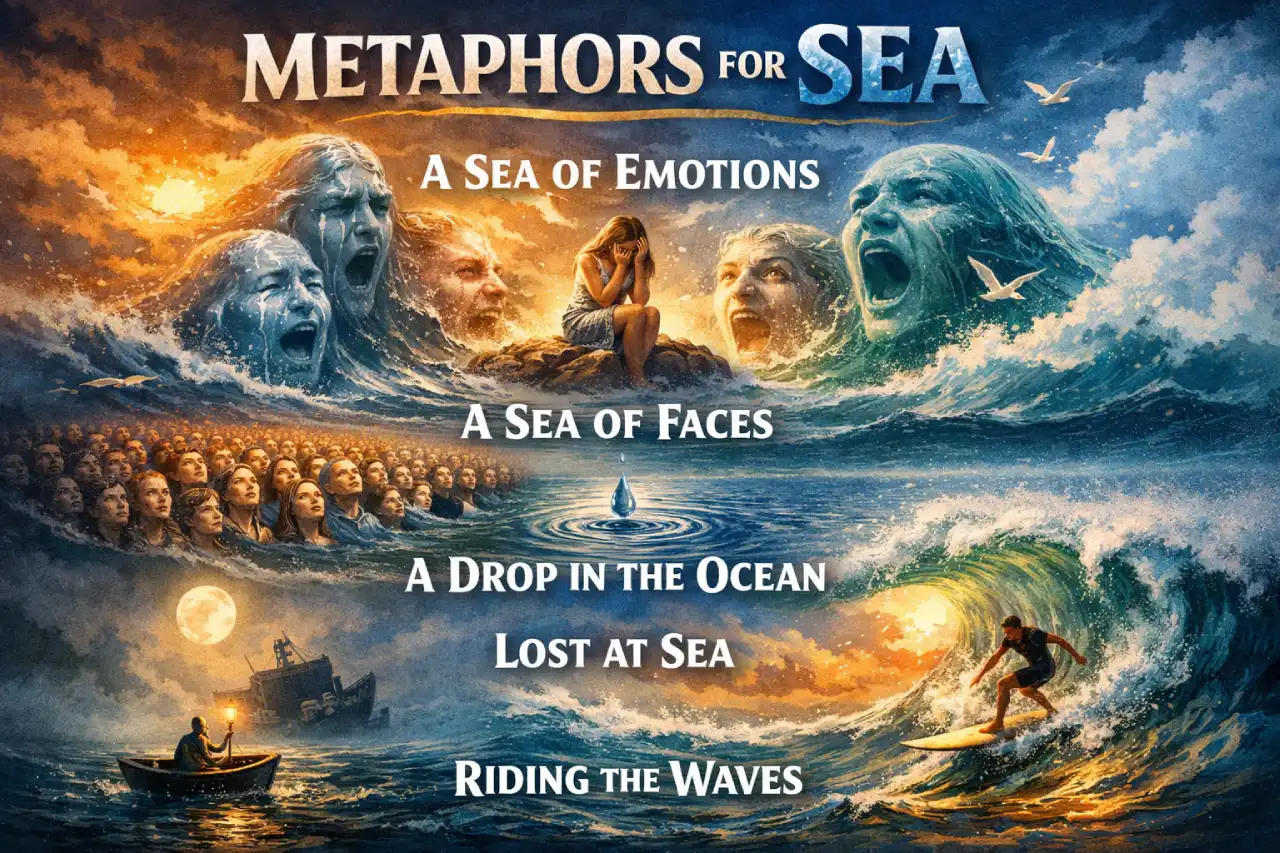
The sea has always inspired writers, poets, and storytellers. Whether it’s calm and peaceful or wild and unpredictable, the sea often becomes a powerful symbol in language. Instead of describing it directly, people use metaphors to capture its depth, mystery, and emotion.
When I started collecting expressions related to the sea, I realized how often we use it to describe life itself—sometimes steady, sometimes chaotic, and sometimes completely unknown. That’s why sea metaphors are not just about water; they reflect feelings, journeys, and experiences.
In this article, I’ve put together 36 metaphors for the sea, each explained in a clear and practical way. You’ll find meanings, one-line sentence examples, alternative expressions, and extra usage notes to help you actually use them in writing or conversation.
Why Sea Metaphors Are So Popular
The sea represents many things at once, which makes it perfect for metaphorical language. It can symbolize:
- Emotions (calm, anger, depth)
- Life journeys and uncertainty
- Freedom and exploration
- Power and danger
Because of this, sea metaphors appear frequently in literature, speeches, and everyday English.
1. A Sea of Emotions
Meaning: A large number of overwhelming feelings.
In a Sentence: She was lost in a sea of emotions after hearing the news.
Other Ways to Say: Flood of feelings, emotional overload.
Usage Tip: Common in emotional storytelling.
Note: Suggests depth and intensity.
2. A Sea of Faces
Meaning: A large crowd of people.
In a Sentence: The performer looked out at a sea of faces in the audience.
Other Ways to Say: Huge crowd, packed gathering.
Usage Tip: Often used in events or public settings.
Note: Emphasizes vastness.
3. A Drop in the Ocean
Meaning: Something very small compared to a larger whole.
In a Sentence: His donation felt like a drop in the ocean compared to the need.
Other Ways to Say: Tiny amount, insignificant part.
Usage Tip: Common in discussions about scale.
Note: Highlights contrast.
4. Lost at Sea
Meaning: Feeling confused or directionless.
In a Sentence: After leaving his job, he felt completely lost at sea.
Other Ways to Say: Confused, uncertain.
Usage Tip: Used for emotional or mental states.
Note: Suggests lack of direction.
5. Riding the Waves
Meaning: Going through ups and downs.
In a Sentence: She’s just riding the waves of her new business journey.
Other Ways to Say: Handling challenges, going with the flow.
Usage Tip: Motivational tone.
Note: Reflects changing situations.
6. The Sea of Time
Meaning: The passage of time over a long period.
In a Sentence: Many traditions have been lost in the sea of time.
Other Ways to Say: Over time, through the years.
Usage Tip: Often used in reflective writing.
Note: Suggests endless time.
7. An Ocean of Opportunities
Meaning: Unlimited possibilities.
In a Sentence: Moving abroad opened an ocean of opportunities for her.
Other Ways to Say: Endless chances, many options.
Usage Tip: Positive context.
Note: Emphasizes abundance.
8. Drowning in Problems
Meaning: Being overwhelmed by difficulties.
In a Sentence: He felt like he was drowning in problems at work.
Other Ways to Say: Overwhelmed, stressed out.
Usage Tip: Common in casual speech.
Note: Strong emotional metaphor.
9. Smooth Sailing
Meaning: Progress without difficulty.
In a Sentence: After the initial struggle, the project was smooth sailing.
Other Ways to Say: Easy progress, no issues.
Usage Tip: Often used in work or plans.
Note: Nautical origin.
10. A Wave of Change
Meaning: A sudden or strong shift.
In a Sentence: The company is experiencing a wave of change.
Other Ways to Say: Major shift, transformation.
Usage Tip: Common in business language.
Note: Suggests movement.
11. Sailing Through Life
Meaning: Living easily without major problems.
In a Sentence: He seems to be sailing through life without worries.
Other Ways to Say: Easy life, carefree living.
Usage Tip: Can be positive or sarcastic.
Note: Reflects ease.
12. A Stormy Sea
Meaning: A difficult or chaotic situation.
In a Sentence: The company went through a stormy sea during the crisis.
Other Ways to Say: Tough period, chaos.
Usage Tip: Dramatic tone.
Note: Symbolizes struggle.
13. Waves of Emotion
Meaning: Strong and recurring feelings.
In a Sentence: Waves of emotion hit him during the speech.
Other Ways to Say: Emotional rush, surge of feelings.
Usage Tip: Emotional writing.
Note: Repetition implied.
14. The Deep Blue
Meaning: The sea itself, often mysterious.
In a Sentence: The ship disappeared into the deep blue.
Other Ways to Say: Ocean, open sea.
Usage Tip: Poetic tone.
Note: Suggests mystery.
15. A Sea Change
Meaning: A major transformation.
In a Sentence: The policy brought a sea change in the system.
Other Ways to Say: Big change, transformation.
Usage Tip: Formal or journalistic use.
Note: Classic expression.
16. Floating Aimlessly
Meaning: Lacking direction.
In a Sentence: He felt like he was floating aimlessly after graduation.
Other Ways to Say: Directionless, uncertain.
Usage Tip: Personal reflection.
Note: Suggests drift.
17. A Rising Tide
Meaning: Increasing influence or improvement.
In a Sentence: A rising tide of innovation is shaping the industry.
Other Ways to Say: Growing trend, upward movement.
Usage Tip: Often used positively.
Note: Economic usage.
18. Lost in the Waves
Meaning: Overwhelmed or unnoticed.
In a Sentence: His voice was lost in the waves of noise.
Other Ways to Say: Ignored, overwhelmed.
Usage Tip: Descriptive writing.
Note: Suggests disappearance.
19. A Sea of Troubles
Meaning: Many problems at once.
In a Sentence: The team faced a sea of troubles during the project.
Other Ways to Say: Numerous issues, many challenges.
Usage Tip: Dramatic tone.
Note: Emphasizes quantity.
20. Chasing the Horizon
Meaning: Pursuing dreams or goals endlessly.
In a Sentence: He spent years chasing the horizon of success.
Other Ways to Say: Pursue dreams, aim high.
Usage Tip: Inspirational tone.
Note: Horizon symbolizes goals.
21. Anchored in Place
Meaning: Unable to move forward.
In a Sentence: Fear kept her anchored in place.
Other Ways to Say: Stuck, unable to progress.
Usage Tip: Emotional context.
Note: Anchor imagery.
22. Drifting Away
Meaning: Gradually losing connection.
In a Sentence: They started drifting away over time.
Other Ways to Say: Growing apart, disconnecting.
Usage Tip: Relationships.
Note: Slow change.
23. A Tide of Support
Meaning: A large amount of support.
In a Sentence: The campaign received a tide of support.
Other Ways to Say: Strong backing, wide support.
Usage Tip: Public events.
Note: Positive tone.
24. Into Deep Waters
Meaning: Entering a difficult situation.
In a Sentence: He realized he was in deep waters after the deal.
Other Ways to Say: Trouble, risky situation.
Usage Tip: Warning tone.
Note: Suggests danger.
25. A Calm Sea
Meaning: Peaceful situation.
In a Sentence: Life felt like a calm sea after the chaos.
Other Ways to Say: Peaceful time, stability.
Usage Tip: Contrast usage.
Note: Opposite of storm.
26. Waves of Change
Meaning: Repeated changes over time.
In a Sentence: The industry is facing waves of change.
Other Ways to Say: Ongoing transformation.
Usage Tip: Business context.
Note: Continuous movement.
27. Beneath the Surface
Meaning: Hidden truth or emotion.
In a Sentence: There was tension beneath the surface.
Other Ways to Say: Hidden issues, underlying problem.
Usage Tip: Subtle writing.
Note: Depth metaphor.
28. A Vast Ocean
Meaning: Something extremely large or endless.
In a Sentence: The internet feels like a vast ocean of information.
Other Ways to Say: Endless space, huge amount.
Usage Tip: General usage.
Note: Scale emphasis.
29. Swept Away by the Tide
Meaning: Carried by emotions or events.
In a Sentence: He was swept away by the tide of excitement.
Other Ways to Say: Overcome, carried away.
Usage Tip: Emotional context.
Note: Loss of control.
30. Sailing Against the Tide
Meaning: Going against common opinion.
In a Sentence: She was sailing against the tide with her ideas.
Other Ways to Say: Going against the flow, opposing views.
Usage Tip: Debate context.
Note: Resistance.
31. A Wave of Relief
Meaning: Sudden feeling of relief.
In a Sentence: A wave of relief washed over him after the results.
Other Ways to Say: Sudden relief, easing stress.
Usage Tip: Emotional writing.
Note: Common phrase.
32. The Endless Sea
Meaning: Something without limits.
In a Sentence: Opportunities seemed like an endless sea before her.
Other Ways to Say: Infinite, boundless.
Usage Tip: Inspirational tone.
Note: Suggests freedom.
33. A Flood of Ideas
Meaning: Many ideas at once.
In a Sentence: He had a flood of ideas during the brainstorming session.
Other Ways to Say: Burst of ideas, creative surge.
Usage Tip: Creative context.
Note: Water imagery.
34. The Roaring Ocean
Meaning: Powerful and uncontrollable force.
In a Sentence: The crowd sounded like a roaring ocean.
Other Ways to Say: Loud force, overwhelming noise.
Usage Tip: Descriptive tone.
Note: Strength imagery.
35. A Sea of Lights
Meaning: A large number of lights.
In a Sentence: The city looked like a sea of lights at night.
Other Ways to Say: Bright display, glowing scene.
Usage Tip: Visual writing.
Note: Popular metaphor.
36. Waves of Inspiration
Meaning: Repeated creative ideas.
In a Sentence: She worked through waves of inspiration all night.
Other Ways to Say: Creative bursts, flowing ideas.
Usage Tip: Creative fields.
Note: Positive expression.
Final Thoughts
Sea metaphors are everywhere because they connect easily with human emotions and experiences. Whether it’s calmness, chaos, growth, or uncertainty, the sea offers a powerful way to describe it.
If you start using these metaphors in your writing or speech, you’ll notice how naturally they fit into different situations. The key is to match the metaphor with the feeling or context you want to express.
If you found this article informative, feel free to check out our other articles as well.