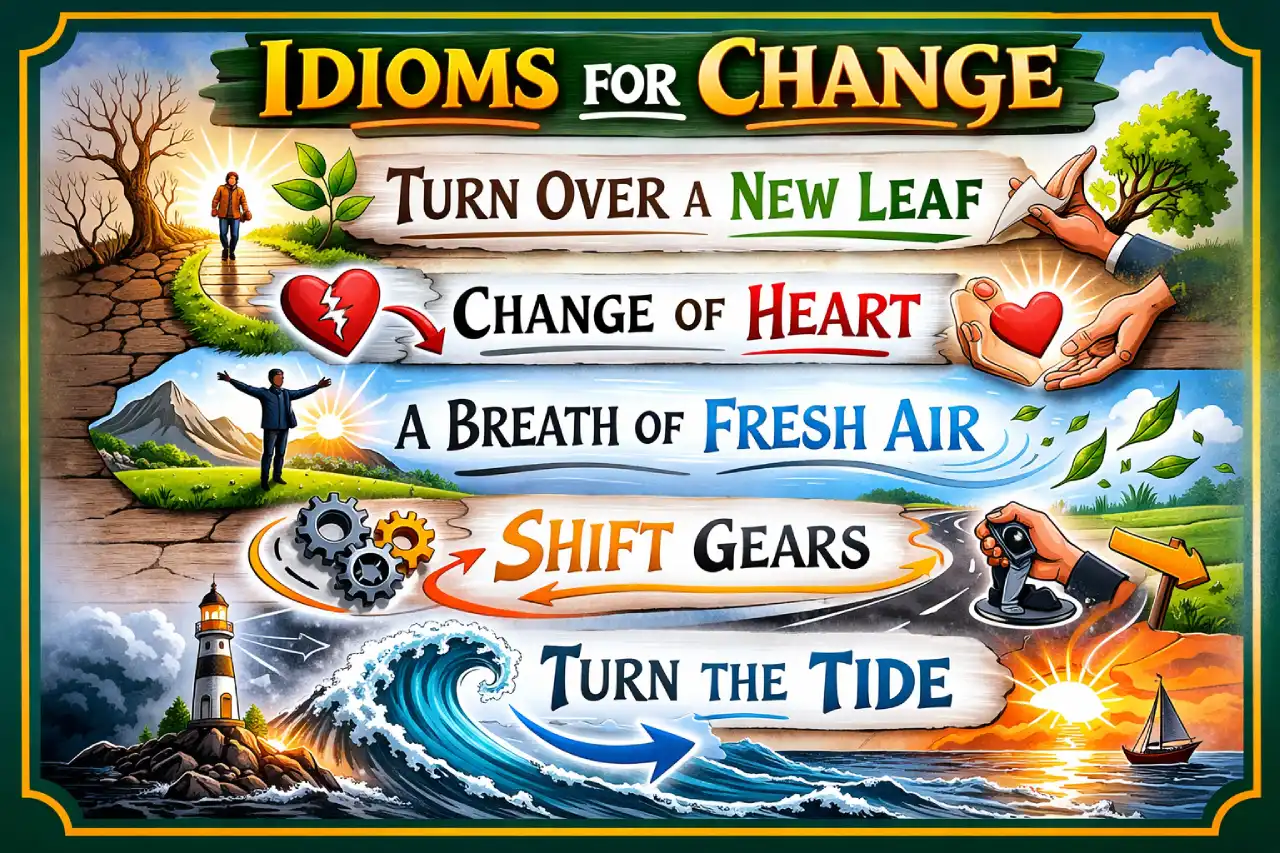
If someone asks how to talk about change in English, the direct answer is simple: you don’t always say “things are changing”—you use idioms. These expressions make your communication sound more natural, whether you’re speaking casually, writing professionally, or telling a story.
From what I’ve seen, idioms about change are everywhere—used in workplaces, daily conversations, and even news reports. They help describe transformation, uncertainty, improvement, and new beginnings in a more vivid way.
Instead of just listing phrases, I’ve picked 33 idioms that people genuinely use when talking about change in real-life situations. Each one includes a clear meaning, a short one-line example, alternative ways to say it, and a couple of practical notes so you can actually use them without confusion.
1. Turn Over a New Leaf
Meaning: Start fresh or change behavior for the better.
In a Sentence: He decided to turn over a new leaf after the mistake.
Other Ways to Say: Make a fresh start, begin again.
Usage Tip: Common in personal improvement contexts.
Note: Suggests positive change.
2. Change of Heart

Meaning: A shift in opinion or feeling.
In a Sentence: She had a change of heart about the decision.
Other Ways to Say: Rethink, reconsider.
Usage Tip: Emotional decisions.
Note: Often sudden.
3. A Breath of Fresh Air

Meaning: Something new and refreshing.
In a Sentence: The new manager was a breath of fresh air.
Other Ways to Say: Refreshing change, new energy.
Usage Tip: Positive change.
Note: Light tone.
4. Shift Gears

Meaning: Change direction or approach.
In a Sentence: The company decided to shift gears and try a new strategy.
Other Ways to Say: Change focus, adjust approach.
Usage Tip: Business context.
Note: From driving.
5. Turn the Tide
Meaning: Reverse a situation.
In a Sentence: The new policy helped turn the tide.
Other Ways to Say: Change outcome, reverse trend.
Usage Tip: Dramatic situations.
Note: Sea imagery.
6. Break the Mold

Meaning: Do something differently from usual.
In a Sentence: She broke the mold with her ideas.
Other Ways to Say: Be unique, innovate.
Usage Tip: Creative contexts.
Note: Positive change.
7. Go Through a Phase

Meaning: Experience a temporary change.
In a Sentence: He’s just going through a phase.
Other Ways to Say: Temporary change, short period.
Usage Tip: Informal usage.
Note: Often emotional.
8. Turn the Corner

Meaning: Start improving after difficulty.
In a Sentence: The business has finally turned the corner.
Other Ways to Say: Improve, recover.
Usage Tip: Recovery situations.
Note: Positive progress.
9. A New Chapter

Meaning: A new stage in life.
In a Sentence: Moving abroad marked a new chapter in her life.
Other Ways to Say: Fresh start, new beginning.
Usage Tip: Life changes.
Note: Book metaphor.
10. Rock the Boat

Meaning: Cause change or disruption.
In a Sentence: He didn’t want to rock the boat at work.
Other Ways to Say: Cause trouble, disrupt.
Usage Tip: Negative tone.
Note: Risky change.
11. Change the Game
Meaning: Transform a situation completely.
In a Sentence: This innovation could change the game.
Other Ways to Say: Revolutionize, transform.
Usage Tip: Business or tech.
Note: Strong impact.
12. Out with the Old, In with the New
Meaning: Replace old things with new ones.
In a Sentence: The company followed an out with the old, in with the new approach.
Other Ways to Say: Replace, renew.
Usage Tip: New beginnings.
Note: Common phrase.
13. A Turning Point
Meaning: A moment of major change.
In a Sentence: That decision was a turning point in his life.
Other Ways to Say: Critical moment, key change.
Usage Tip: Important events.
Note: Significant shift.
14. Break New Ground
Meaning: Do something innovative.
In a Sentence: The research broke new ground.
Other Ways to Say: Innovate, pioneer.
Usage Tip: Professional context.
Note: Positive progress.
15. Change of Pace
Meaning: A different routine or activity.
In a Sentence: The trip was a nice change of pace.
Other Ways to Say: Variation, break from routine.
Usage Tip: Casual usage.
Note: Refreshing change.
16. Go with the Flow

Meaning: Accept change easily.
In a Sentence: She prefers to go with the flow.
Other Ways to Say: Adapt, accept.
Usage Tip: Relaxed tone.
Note: Flexibility.
17. Shake Things Up
Meaning: Make big changes.
In a Sentence: The company wants to shake things up.
Other Ways to Say: Change drastically, disrupt.
Usage Tip: Business context.
Note: Energy.
18. Turn Things Around
Meaning: Improve a bad situation.
In a Sentence: They managed to turn things around.
Other Ways to Say: Fix, improve.
Usage Tip: Recovery.
Note: Positive change.
19. Step Into a New Role

Meaning: Take on a new responsibility.
In a Sentence: She stepped into a new role at work.
Other Ways to Say: Take responsibility, move forward.
Usage Tip: Career growth.
Note: Transition.
20. Change Tracks
Meaning: Switch direction.
In a Sentence: He decided to change tracks in his career.
Other Ways to Say: Shift path, redirect.
Usage Tip: Career context.
Note: Railway metaphor.
21. Flip the Script
Meaning: Reverse expectations.
In a Sentence: The story flipped the script completely.
Other Ways to Say: Reverse roles, surprise.
Usage Tip: Creative writing.
Note: Modern usage.
22. A Fresh Start
Meaning: Begin again.
In a Sentence: She moved cities for a fresh start.
Other Ways to Say: New beginning, restart.
Usage Tip: Life change.
Note: Positive tone.
23. Move the Needle

Meaning: Make noticeable progress.
In a Sentence: The changes didn’t move the needle much.
Other Ways to Say: Make an impact, progress.
Usage Tip: Business usage.
Note: Measurement metaphor.
24. Turn the Tables
Meaning: Reverse a situation.
In a Sentence: They turned the tables in the second half.
Other Ways to Say: Reverse roles, change outcome.
Usage Tip: Competitive context.
Note: Strategy.
25. Evolve Over Time
Meaning: Gradually change.
In a Sentence: His thinking evolved over time.
Other Ways to Say: Develop, grow.
Usage Tip: Long-term change.
Note: Natural process.
26. Make a Comeback
Meaning: Return after decline.
In a Sentence: The company made a strong comeback.
Other Ways to Say: Recover, return.
Usage Tip: Success stories.
Note: Positive shift.
27. Reinvent Yourself
Meaning: Change identity or approach.
In a Sentence: She reinvented herself after the setback.
Other Ways to Say: Transform, rebrand.
Usage Tip: Personal growth.
Note: Strong change.
28. Take a New Direction
Meaning: Choose a different path.
In a Sentence: The project took a new direction.
Other Ways to Say: Shift focus, change course.
Usage Tip: Planning.
Note: Movement metaphor.
29. Change for the Better
Meaning: Improve.
In a Sentence: Things changed for the better.
Other Ways to Say: Improve, get better.
Usage Tip: Positive tone.
Note: Simple phrase.
30. Change for the Worse
Meaning: Become worse.
In a Sentence: The situation changed for the worse.
Other Ways to Say: Decline, worsen.
Usage Tip: Negative tone.
Note: Opposite meaning.
31. A Whole New Ball Game
Meaning: A completely different situation.
In a Sentence: The new rules made it a whole new ball game.
Other Ways to Say: Different scenario, new challenge.
Usage Tip: Informal tone.
Note: Sports origin.
32. Turn the Page
Meaning: Move on to something new.
In a Sentence: It’s time to turn the page and move forward.
Other Ways to Say: Move on, start fresh.
Usage Tip: Emotional tone.
Note: Book metaphor.
33. Shift the Balance
Meaning: Change the situation or power.
In a Sentence: The decision shifted the balance in their favor.
Other Ways to Say: Change dynamics, alter outcome.
Usage Tip: Strategic context.
Note: Subtle change.
Final Thoughts
Change is a constant part of life, and having the right expressions makes it easier to talk about it clearly and naturally. These idioms help you describe everything from small adjustments to major life transformations.
If you start using them in conversations or writing, you’ll notice how much more natural and expressive your English becomes.
If you found this article informative, feel free to check out our other articles as well.